
There is a moment at every track day when you pull into the paddock, look at the bloke next to you, and realise he has swapped his rubber out entirely. Proper semi-slicks. Tyres that look like they belong on a racing prototype rather than a school run. And suddenly your road-legal Michelin Pilot Sport 5s feel a bit… pedestrian. So what is actually going on with track day tyres, and does it genuinely matter which compound you bolt on? Let’s get into it properly, because the differences are bigger than most people realise.
Whether you are hammering a hot hatch around Brands Hatch or pushing a tuned saloon at Anglesey Circuit, understanding the tyre underneath you is arguably the single most important performance variable you can influence. It is also a subject full of myths, misinformation, and some genuinely crucial legal detail that could catch you out.

What Actually Makes Track Day Tyres Different from Road Tyres?
The core difference comes down to compound and construction. Road tyres are engineered to work across an enormous range of conditions, cold British mornings, wet motorways, gravel-dusted roundabouts, and to last somewhere between 15,000 and 35,000 miles depending on how you drive. That versatility requires compromises. The rubber compound is harder, the tread pattern is optimised for water evacuation, and the whole thing is built to stay predictable at everyday temperatures.
Track-oriented tyres flip those priorities entirely. A semi-slick like the Toyo R888R or the Nankang NS-2R runs a far softer compound that operates in a much narrower temperature window. Below that window, they can actually feel less grippy than a decent road tyre. Get them up to temperature on circuit, though, and the difference is night and day. Lateral grip, braking distances, feedback through the steering, everything sharpens up dramatically. You are essentially sacrificing longevity and cold-weather performance for peak capability when it counts.
Slick tyres, which have no tread whatsoever, take this to the extreme. They maximise the contact patch with the tarmac for maximum dry grip. But here is the thing, you almost certainly will not be running slicks unless you are doing dedicated motorsport, not a public track day. Most track day organiser rules, and certainly your insurance policy, draw a firm line there.
Are Track Day Tyres Legal on UK Roads?
This is where it gets interesting. Semi-slick tyres with some tread pattern, like the Toyo R888R or the Federal RS-R, are technically road legal provided they meet the minimum 1.6mm tread depth requirement as outlined by the Driver and Vehicle Licensing Agency (DVLA) and gov.uk vehicle standards guidance. You can, in theory, drive to the circuit, do your session, and drive home.
In practice, though, there are real caveats. Fully slick tyres are not road legal, full stop. Semi-slicks in cold or wet conditions can be genuinely dangerous on the road because they have not reached operating temperature. And there is the matter of wear rate. A set of R888Rs might last you a couple of track days and then they are done. Running them on the road eats through them even faster. Most serious track day enthusiasts end up running a dedicated set of wheels for the circuit and swapping back to road rubber for the drive home.
For a deep dive into what you can legally modify on your car for road and track use, our guide to the coolest legal car mods in the UK in 2026 covers a lot of the grey areas worth knowing about.
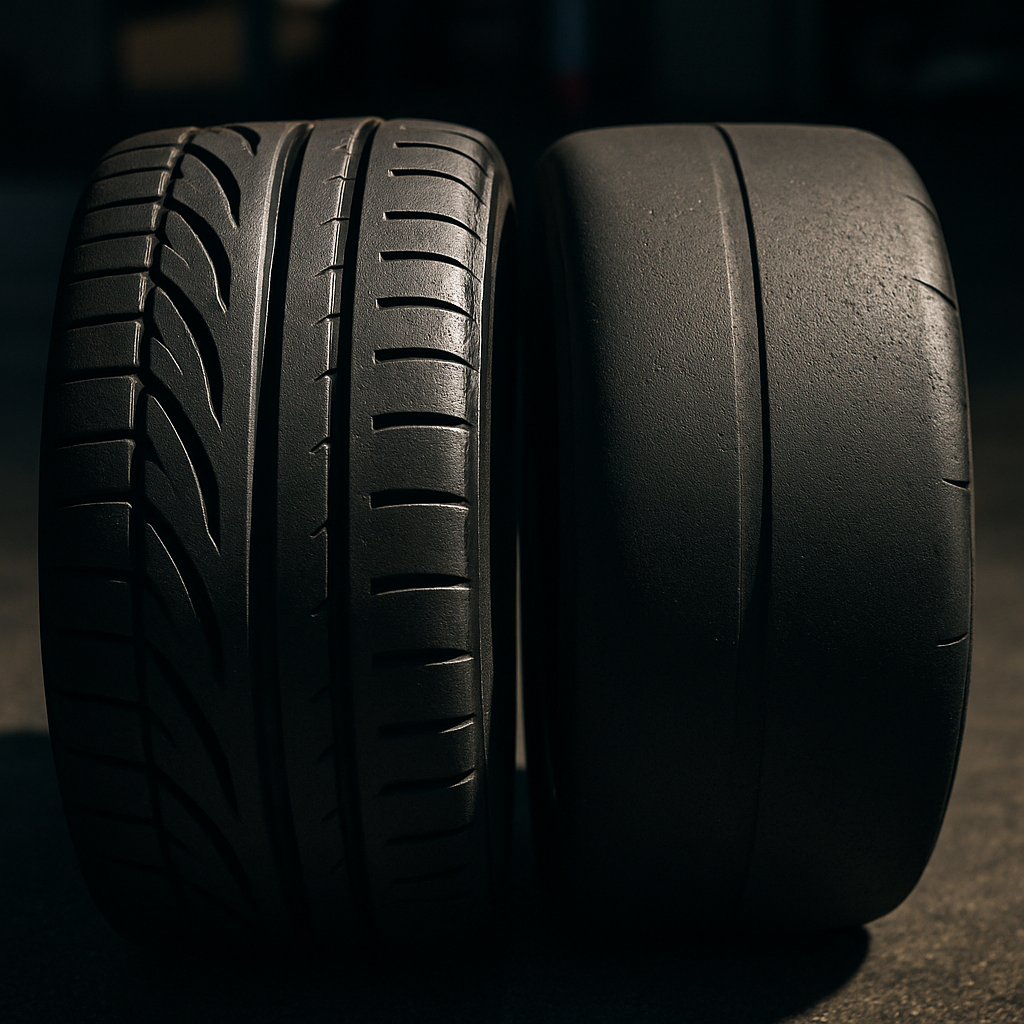
Performance on Track: Semi-Slicks vs Road-Legal Performance Tyres
Let us talk numbers for a second, because it helps ground this conversation in reality. A quality performance road tyre in 2026, say the Michelin Pilot Sport 5, Bridgestone Potenza Sport, or Continental SportContact 7, will give you genuinely impressive grip on circuit. Do not let anyone tell you otherwise. These are excellent tyres. But a semi-slick will typically offer 10-20% more lateral grip once warmed up, with markedly shorter braking distances and much clearer feedback at the limit.
That feedback is underrated. When you are learning the limits of your car, knowing when the tyre is beginning to slide, rather than just suddenly losing the plot, is enormously valuable. Semi-slicks communicate better. They give you more warning. That can actually make certain drivers faster and safer on circuit, even if the raw grip numbers seem intimidating.
Best Track Day Tyres UK 2026: What to Actually Buy
The market has matured nicely. Here are the options worth knowing about right now.
For Full Track Use (Semi-Slick)
The Toyo Proxes R888R remains the gold standard for track day enthusiasts in the UK. Brilliant feedback, available in a wide range of sizes, holds up reasonably well over multiple sessions. The Nankang NS-2R is the budget-conscious choice and punches well above its price point, it has earned serious respect in the UK track day community. The Federal 595 RS-RR sits somewhere between the two on price and is well regarded for front-wheel-drive hot hatch setups specifically.
For Road Use with Track Ambitions
If you are not ready to run a separate track wheel setup, the Michelin Pilot Sport Cup 2 is the undisputed king of the dual-use world. It is road legal, it handles wet weather considerably better than a true semi-slick, and on a dry circuit it is devastatingly fast. The catch is the price, expect to pay significantly more than a standard performance tyre. The Bridgestone Potenza RE-71RS is another strong contender in this category, particularly for time attack and club level competition.
For the Weekly Driver Who Also Does Track Days
If you are keeping one set of tyres and splitting time between road and occasional circuit use, the Continental SportContact 7 and the Goodyear Eagle F1 SuperSport are both exceptional. They will not match the pure lap time of a Cup 2, but the difference in real-world conditions and longevity is significant. Sensible choice for someone who tracks their car two or three times a year.
Safety Considerations Nobody Talks About Enough
Tyre pressure is massively misunderstood in the track day context. Road tyres typically run at manufacturer-specified pressures because they are designed to operate across a broad temperature range. Semi-slicks heat up more aggressively and expand accordingly. Starting too high on pressure can cause handling imbalances and uneven wear mid-session. Most semi-slick manufacturers publish recommended starting pressures for track use, and they are often lower than you might expect, around 1.7 to 2.0 bar cold, depending on the compound and car.
Tyre age matters too. The rubber compounds in performance and semi-slick tyres degrade over time regardless of tread depth. Anything over five years old should be treated with real caution on circuit, even if it looks fine visually. Check the DOT date code on the sidewall, the last four digits tell you the week and year of manufacture.
For anyone building a car specifically around track days, understanding how every component interacts with tyre behaviour is essential reading. Our breakdown of the best affordable hot hatches for thrashing on track in 2026 covers how setup choices compound the tyre variable considerably.
The Bottom Line on Track Day Tyres UK 2026
If you are serious about getting faster and safer on circuit, the tyre conversation is unavoidable. Road tyres are brilliant for the road, that is what they are built for. Semi-slicks unlock a different level of capability once temperatures are up, with better communication, more grip, and a more rewarding experience at the limit. The practical reality for most UK enthusiasts is a second set of wheels with semi-slicks for the track, paired with a quality performance road tyre for everything else. It costs more upfront, but the improvement in both safety and enjoyment on circuit is genuinely transformative.
Frequently Asked Questions
Can I use track day tyres on public roads in the UK?
Semi-slick track tyres with a visible tread pattern above 1.6mm depth are generally road legal in the UK. However, fully slick tyres with no tread are not road legal under any circumstances. Be aware that semi-slicks in cold or wet conditions can perform poorly on the road as they need heat to reach their operating window.
How long do track day tyres last in the UK?
This varies significantly by compound and driving style, but most semi-slick tyres will last between two and six track day sessions depending on how hard you push. Running the same tyres on the road dramatically accelerates wear. Budget accordingly, semi-slicks are a consumable, not a long-term investment.
What is the difference between a semi-slick and a road-legal performance tyre?
A semi-slick uses a softer compound with minimal tread pattern optimised for maximum dry grip at elevated temperatures, while a performance road tyre uses a harder compound designed to work across all weather conditions and temperatures. Semi-slicks offer more grip on a dry circuit but degrade faster and can be dangerous in cold or wet conditions.
What tyre pressure should I use for track days?
Recommended starting pressures for semi-slick tyres on track are typically lower than road pressures, often around 1.7 to 2.0 bar cold. Always check the specific manufacturer’s guidance for your tyre as pressures build significantly once the rubber heats up. Using a quality tyre pressure gauge between sessions is essential.
What are the best semi-slick tyres for UK track days in 2026?
The Toyo Proxes R888R is widely considered the benchmark for enthusiast track days in the UK, offering excellent feedback and a wide size range. The Nankang NS-2R is a strong budget option that has earned genuine respect in UK track day circles. For dual road and track use, the Michelin Pilot Sport Cup 2 is the premium choice.